
Vetting a garage door company before hiring takes a short set of checks covering licensing, insurance, reputation, and pricing before any technician sets foot on the property. Skipping even one of these checks removes the protection that keeps a routine repair from turning into a financial or safety problem later on.
Companies that hesitate on any of these checks are rarely worth the risk of moving forward regardless of price or availability. This guide walks through the exact steps that confirm a company is legitimate, including how to tell a properly run business apart from garage door repair work performed by someone with no license or accountability at all.
Key Takeaways
- Verifying a license number against the state database takes minutes and prevents most licensing-related losses.
- Insurance should be confirmed directly with the provider, not assumed from a certificate alone.
- Written estimates from at least three companies expose pricing gaps before any commitment is made.
- A missing physical address or high-pressure sales tactic often signals a company worth avoiding entirely.
- Vetting protects the manufacturer warranty, the household budget, and the safety of everyone using the door.
Steps to Take Before Hiring a Garage Door Company
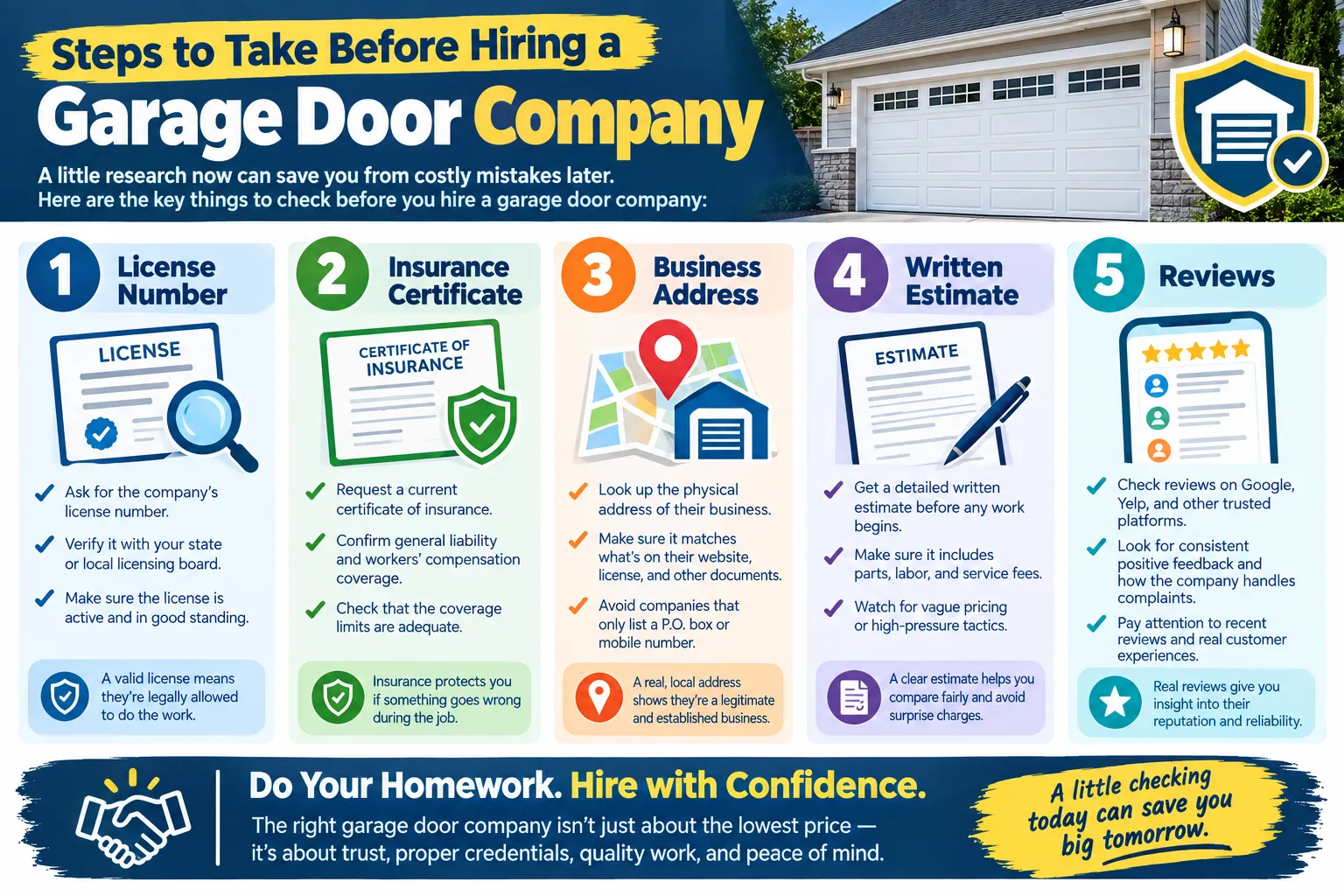
Vetting a garage door company before hiring protects the household budget, the door itself, and the safety of everyone who uses it.
Vetting Step | What Confirms It’s Legitimate | What Signals a Problem |
License Number | Matches an active record in the state database | Number does not match any record on file |
Insurance Certificate | Provider confirms active coverage under the company name | Coverage is expired or cannot be confirmed |
Business Address | A physical location is confirmed through mapping tools | Address is a P.O. box or virtual office |
Written Estimate | Labor and parts are itemized and consistent with other quotes | Pricing sits far below every other estimate received |
Reviews | Consistent, verifiable feedback appears across platforms | Reviews are absent, generic, or clearly duplicated |
An unlicensed or uninsured company hired without proper vetting can make serious mistakes with no one left to hold responsible.
Check Licensing and Insurance
A valid license and active insurance policy form the foundation of a legitimate hire, and neither should be taken on faith.
Confirming both starts with these checks:
- Request the license number and search it against the state licensing database.
- Ask for proof of general liability and workers compensation coverage.
- Call the insurance provider to confirm active coverage under the company name.
- Compare the invoice license number against the one given on the initial call.
- Decline to schedule if either document cannot be produced.
Producing both documents without hesitation, even during an emergency garage door repair, means a company has nothing to hide.
Research Reputation and Reviews
Reviews on independent platforms reveal patterns that a company’s own website or sales pitch will never show on its own.
A reliable reputation history surfaces through these checks:
- Check Google, Yelp, and Better Business Bureau listings for the business name.
- Look for complaints tied to dishonesty, poor garage door maintenance or repair workmanship.
- Read a mix of recent and older reviews, not only the most visible ones.
- Cross-reference the business name against listings under a slightly different name.
- Note how the company responds publicly to any negative reviews.
Reading the full range of feedback posted about a company reflects the real experience of past customers far more accurately than a single testimonial.
Ask the Right Questions
A short phone conversation before booking reveals more about a company than most homeowners realize going in.
The following questions belong in that first call:
- How long has the company operated under its current business name.
- Whether the technicians are in-house employees or third-party subcontractors.
- What warranty coverage applies to both labor and parts used in the repair.
- How the company handles a repair that fails shortly after completion.
- For a service address that can be verified independently before booking.
To recognize when these answers signal a manipulative sales pitch instead of a straight one, read our guide on How to Recognize a Garage Door Scam Pitch, which breaks down the exact phrases and pressure tactics scammers rely on during this stage.
Get Multiple Estimates
Written estimates from more than one company expose pricing gaps that a single quote never reveals on its own.
Making the comparison count means doing the following:
- Request written estimates from at least three different companies before booking.
- Compare the itemized labor and parts costs listed on each estimate side by side.
- Treat an estimate priced far below the others as a reason to ask more questions.
- Confirm each estimate includes the same scope of work before comparing totals.
- Save every written estimate in case a dispute needs documentation later on.
To understand what an unusually low estimate often signals about the work behind it, read our guide on The Hidden Risks of Hiring the Cheapest Garage Door Company, which breaks down the parts, labor, and liability shortcuts a low bid frequently hides.
Confirm the Company Has Nothing to Hide
Legitimate businesses welcome scrutiny, while one with something to hide tends to resist basic verification at every step.
A company operating in the open will clear each of these:
- Confirm a real, physical business address using an independent mapping tool.
- Decline any pressure to add upgrades or repairs beyond the original request.
- Refuse to pay a full deposit or the total cost before any type of garage door service begins.
- Ask directly why a technician arrived in an unmarked vehicle, if one did.
- Walk away from any company that avoids a direct answer to a direct question.
Comparing verification results against a few reference points turns a vague sense of doubt into a documented, confirmed answer within minutes.
What to Do Once Vetting Is Complete?
A company that passes every step above has demonstrated the licensing, insurance, and transparency a repair depends on for its entire duration.
The next move depends entirely on how the company performed across each check:
- Book the job with confidence if every document was produced without hesitation.
- Request the missing documentation again if one check came back incomplete.
- Move on to a different company if a license or insurance check fails outright.
- Save copies of every document collected in case a dispute comes up later.
- Revisit the written estimates if pricing seems disconnected from the verification results.
To recover from a repair that goes wrong despite a passed check, read our guide on How to Recover From a Bad Garage Door Hire, which covers documenting damage, contacting the manufacturer, and requesting a written quote for the repair.
Always Verify a Company Before Hiring to Avoid Financial Risk
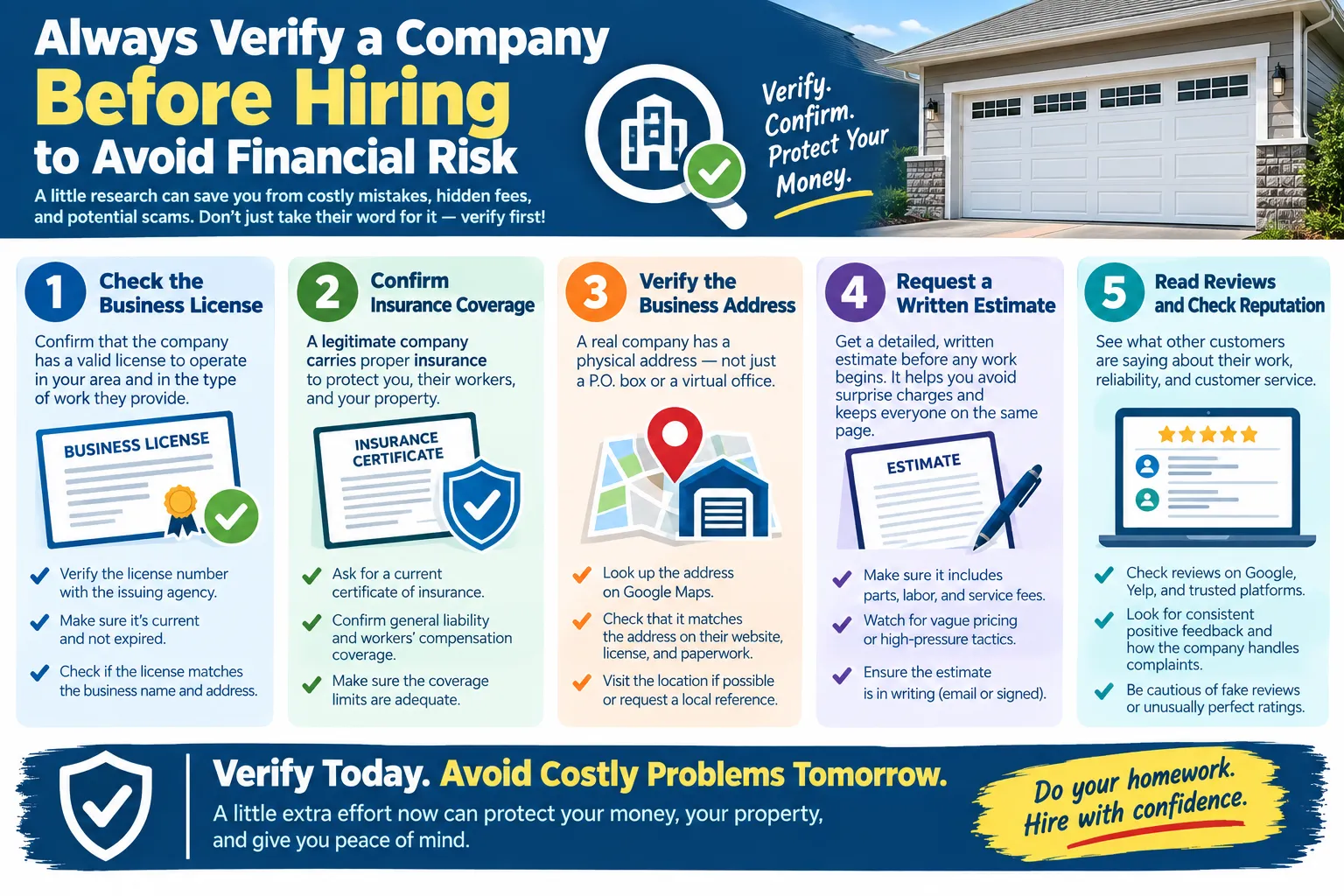
Every step in this process exists to confirm one thing, that the company standing in the garage carries the license, insurance, and accountability the job requires from start to finish. A few minutes of verification consistently prevents the financial and safety exposure that follows a company that cannot answer basic questions.
Davis Overhead Doors, LLC provides verifiable licensing, insurance, and years of experience on every job completed for homeowners across Cleveland, TX. Contact us or give us a call today, and let our team show the documentation a legitimate company should always have ready.