
Hiring the cheapest garage door company often costs more than a fair-priced hire once repair bills, safety hazards, and voided warranties are added together. A low quote can look appealing at first glance, but it frequently signals a shortcut in parts, labor, or licensing that only becomes obvious once the work is already finished.
Homeowners rarely question a company that arrives quickly and quotes a suspiciously low price, which is exactly what cheap operators count on. This guide covers the common tactics behind these pitches, the warning signs that signal a bad hire, and how to verify a company properly before any garage door repair begins.
Key Takeaways
- The cheapest quote often hides fees for labor, travel, or disposal that surface once the job is underway.
- Uninsured workers create real financial liability if someone is injured while on the property.
- Improperly installed parts frequently void manufacturer warranties on the door and opener.
- Confirming a license number and physical address takes only minutes and prevents most bad hires.
- Filing a report quickly improves the odds of recovering money after a scam.
Common Tactics Cheap Garage Door Companies Use
Comparing a quote against a few reference points makes a manufactured bargain far easier to recognize before signing anything.
Tactic Used | What It Sounds Like | What It Usually Hides |
Phone lowball | “We can do it today for half of what others quoted.” | A price increase once the technician is already on site |
Manufactured urgency | “This spring could snap within the hour.” | Pressure to skip comparing other quotes or checking credentials |
Cash-only demand | “We only take cash, it keeps the price lower for you.” | No receipt, no paper trail, and no way to dispute the charge |
Verbal-only estimate | “I’ll just tell you the total once I’m done.” | No itemized breakdown of parts, labor, or added fees |
Unmarked arrival | A plain vehicle with no company name, logo, or license number. | An operator with no traceable business address or license |
A legitimate showroom to visit in person confirms a company is carrying real overhead, not running a manufactured bargain.
Signs a Garage Door Quote Is Too Good to Be True
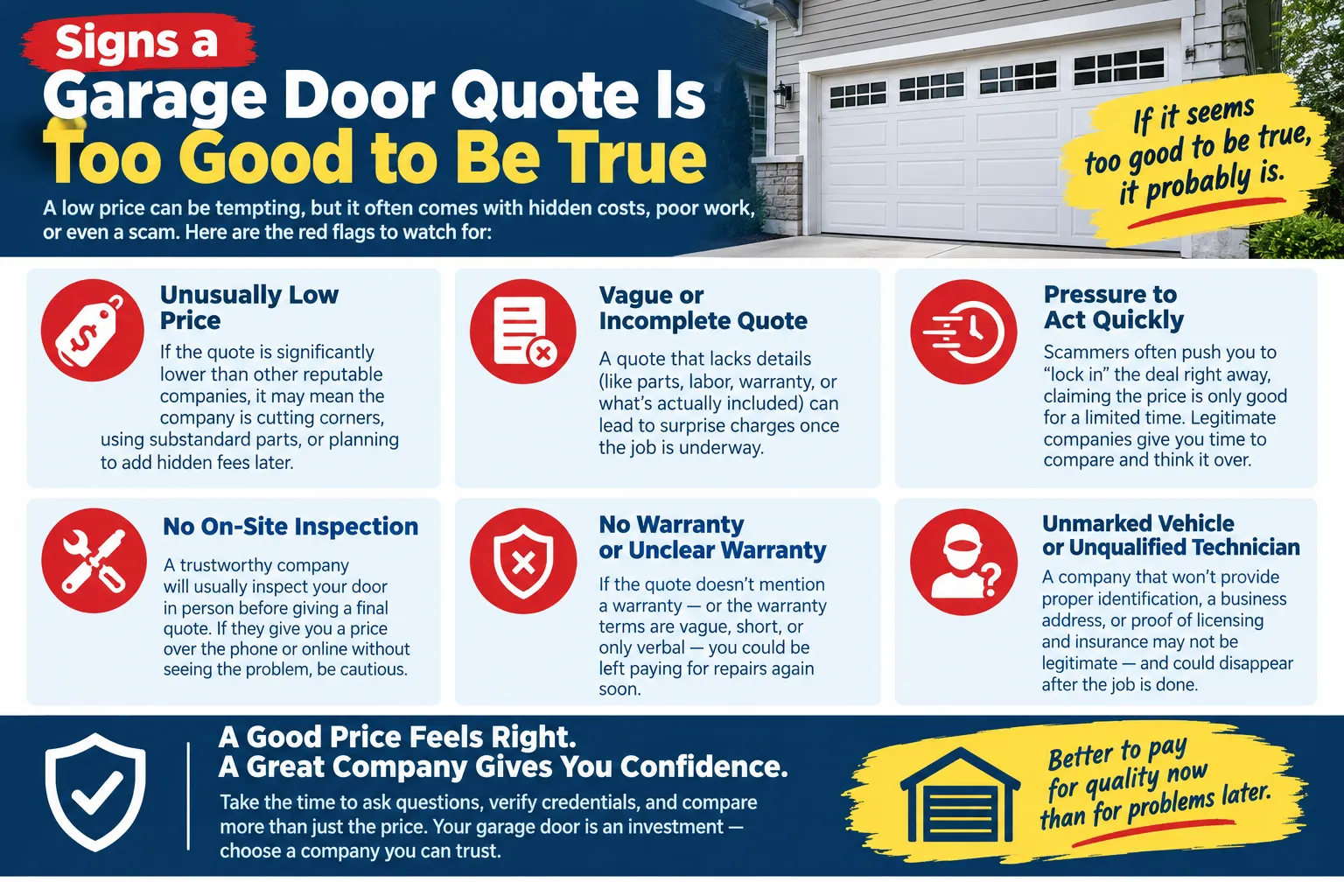
A quote that sits well below every competing bid usually reflects a shortcut somewhere in labor, parts, or licensing rather than a genuine discount.
The following signs separate a fair price from a manufactured bargain:
- The price sits far below every other quote received, with no explanation for the gap.
- No license number appears on the invoice, the website, or the service vehicle.
- The company has no local physical address or clearly listed service area.
- A written estimate never gets provided before or after the work is completed.
- Same-day pressure gets applied, with a discount offered only if the homeowner agrees immediately.
To recognize these patterns during the sales call itself, read our guide on How to Recognize a Garage Door Scam Pitch, which breaks down the exact phrases and pressure tactics scammers rely on most.
How to Check if a Garage Door Company Is Legitimate
Verifying a company before hiring takes only a few minutes and prevents most of the damage a bad hire causes later on.
A short sequence of checks confirms whether a company is legitimate:
- Search the state licensing database instead of trusting a printed number.
- Call the insurance provider to confirm active coverage under the company name.
- Confirm a physical business address through an independent mapping tool.
- Request a written estimate with parts and labor listed separately.
- Check reviews on an independent platform instead of on-site testimonials.
To complete this verification process in the right order, read our guide on How to Vet a Garage Door Company Before Hiring, which walks through each check, explains what it actually confirms, and shows what to do if something does not check out.
Hidden Risks of Hiring the Cheapest Company
Low Quality Parts
Cheap garage door installation work often relies on parts built to the lowest possible price rather than long-term durability.
These substitutions show up most often in cheap installations:
- Weak torsion springs replace springs rated for the actual door weight.
- Thin, low-gauge cables replace the gauge the manufacturer specifies.
- Flimsy plastic rollers replace steel or nylon rollers built for daily use.
- Off-brand safety sensors replace sensors matched to the opener model.
- Generic panels replace panels matched to the original door profile.
Parts built to the lowest price point tend to fail within months, turning one cheap repair into two or three separate paid visits over time.
Poor Workmanship
Inexperienced technicians frequently skip the precision steps that keep a garage door operating safely day to day.
The most common installation errors include the following:
- Tracks get installed slightly misaligned, causing the door to bind or jump.
- Garage door torsion springs get tensioned incorrectly, creating uneven lifting force on each side.
- Cables get wound unevenly, straining one side of the door assembly.
- Opener force settings stay at default instead of matching the door weight.
- Safety reversal sensors get aimed incorrectly, letting the door close without stopping.
A door that closes unevenly or drops without warning is never a minor inconvenience, since either issue can cause real injury.
Hidden Fees
A low initial quote frequently excludes real costs that only appear once the technician has already begun the job on site.
Extra charges tend to appear in one of these forms:
- A separate travel or trip fee gets added once the technician arrives.
- Disposal charges get billed for removing the old parts or door.
- Labor gets billed hourly instead of at the quoted flat rate.
- A rush fee gets added for service originally advertised as free.
- Additional parts get declared necessary mid-repair at a steep markup.
An estimate with no itemized breakdown of parts and labor leaves room for nearly any unexpected charge to appear later.
Voided Warranties
Manufacturer warranties on doors and openers depend on specific parts and installation methods that cheap companies often skip.
Coverage typically ends for one of these reasons:
- Non-standard springs or cables replace the parts the manufacturer specifies.
- The opener gets installed without the safety sensors the warranty requires.
- Panels from another manufacturer replace the matched replacement panels.
- Installation steps get skipped that the manufacturer requires for coverage.
- No documentation shows which parts were installed or when.
Warranty coverage that quietly disappears leaves the full cost of any future failure on the homeowner instead of the manufacturer.
Uninsured Workers
A technician without insurance shifts significant financial risk onto the property owner the moment an accident occurs.
That missing coverage creates exposure in several forms:
- Medical costs from an on-site injury can become the homeowner’s responsibility.
- Property damage during the repair may not be covered by any policy.
- A lawsuit becomes far more likely without a policy to cover the claim.
- Homeowners insurance may deny a claim tied to uninsured work.
- No proof of coverage leaves no clear path to compensation.
Confirming active insurance before work begins remains one of the fastest ways to avoid this exposure entirely.
Zero Accountability
Fly-by-night operators are built from the start to disappear quickly the moment a repair fails or a formal complaint gets filed against them.
The company’s disappearance usually follows a recognizable pattern:
- Phone numbers go disconnected once payment has already been collected.
- No physical address exists to visit or send a complaint to.
- Reviews mentioning problems get deleted or never appear anywhere.
- The business name changes between jobs, making complaints hard to trace.
- No callback gets offered even when the same repair fails again.
A company that cannot be reached after the sale offers no real path to a refund, repair, or any lasting resolution for the homeowner at all.
How to Report a Garage Door Scam
Reporting a scam quickly improves the odds of recovering money and helps prevent the same company from targeting another homeowner.
The most effective reports usually follow this sequence:
- File a complaint with the Better Business Bureau, including a copy of the estimate or receipt.
- Report the company to the state licensing board if no license number can be confirmed.
- Dispute the charge with the card issuer or bank if payment was made electronically.
- Warn others with a factual, detailed review on an independent platform.
- Contact local authorities if the situation involves theft or clear intent to defraud.
Submitting more than one of these reports at the same time builds a stronger, better-documented record than relying on a single complaint alone.
How to Recover From a Bad Garage Door Company Hire
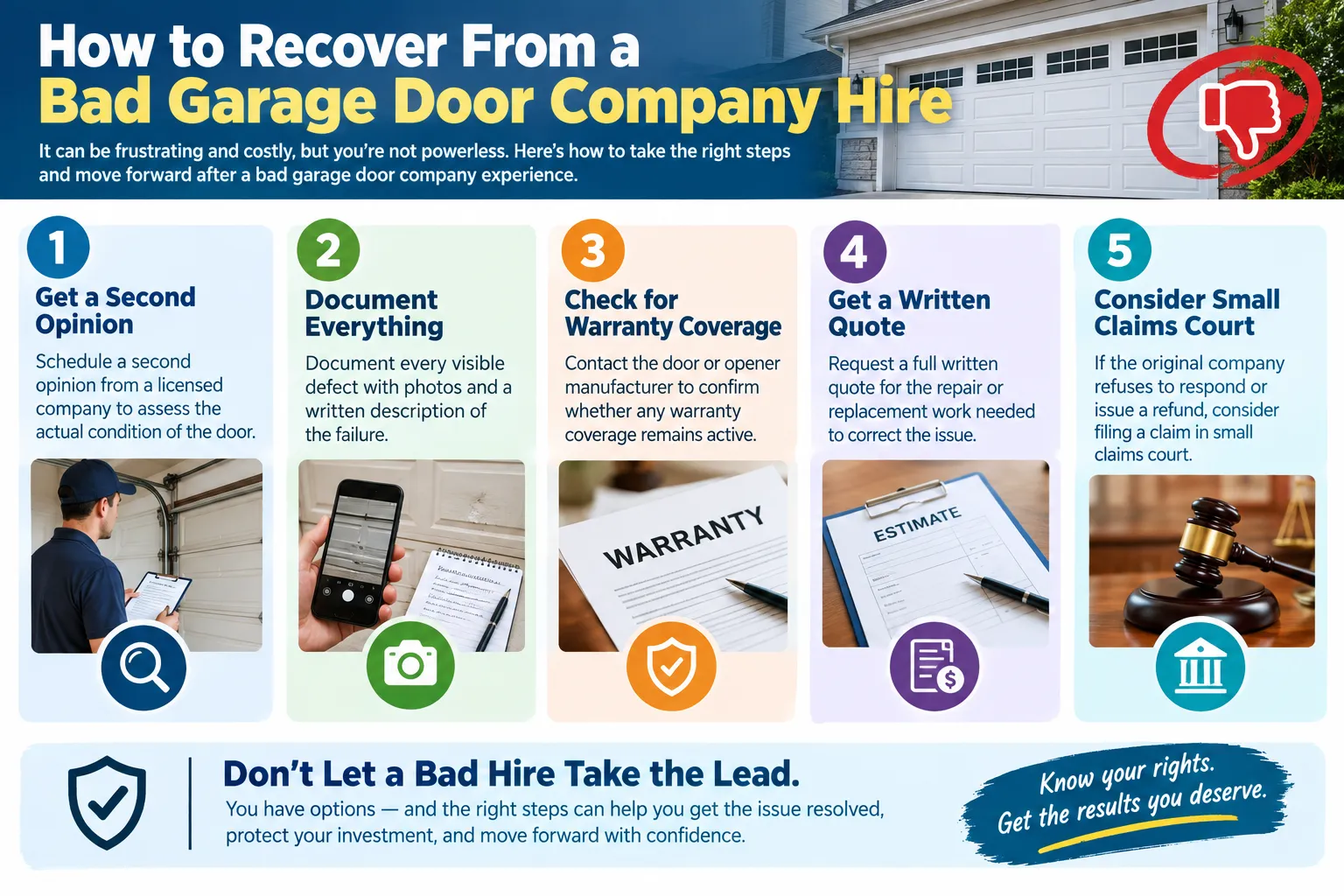
A bad hire rarely marks the end of the situation, since most of the damage can still get corrected with the right next steps.
- Schedule a second opinion from a licensed company to assess the actual condition of the door.
- Document every visible defect with photos and a written description of the failure.
- Contact the door or opener manufacturer to confirm whether any warranty coverage remains active.
- Request a full written garage door maintenance quote for the repair or replacement work needed to correct the issue.
- Consider small claims court if the original company refuses to respond or issue a refund.
To walk through each of these steps in more detail, read our guide on How to Recover From a Bad Garage Door Hire, which covers what to document, who to contact, and when legal action becomes worth pursuing.
The Cheapest Quote Often Costs More in the End
A fair-priced hire from a licensed, insured company protects the door, the household budget, and the safety of everyone who uses the garage every day. The extra cost of hiring correctly the first time is almost always smaller than the combined cost of repairs, disputes, and lost warranty coverage that follow a cheap hire gone wrong.
Davis Overhead Doors, LLC completes licensed, warranty-eligible work for homeowners across Cleveland, TX who want the repair done right the first time, every time. Contact us or give us a call today, and let our technicians confirm the credentials that matter before any work begins.